Solar or a trenched power line for your driveway gate, why solar gates slow down in winter, and what to check before you call.
Reviewed by the Austin Estate Gate team · Owner-led, 17+ years
Yes, a solar gate opener works in Central Texas, and on a lot of Hill Country properties it is the better choice. The deciding question is how far the gate sits from house power. When a line would have to be trenched a long way through caliche and limestone, a solar package is usually the cheaper and faster answer. Solar works as long as three things hold: the panel sees open sky, the battery is healthy, and the gate does not cycle more than the panel can put back each day. Here is how we decide between solar and a wired line, why solar gates are the ones that quit first when the days get short, and what you can check yourself before you call.
How does a solar gate opener work?
The battery runs the gate. The solar panel only refills the battery. That one fact explains almost every solar gate problem we get called out for.
A solar gate system has four parts: the panel, mounted on the gate post or a nearby pole; a charge controller that keeps the panel from over- or under-charging the battery; the battery itself, usually inside the operator box; and an operator built to run on battery power. Every time the gate opens and closes, it draws from the battery. During the day the panel puts that charge back. At night and on cloudy days, the gate runs on what the battery stored.
Most residential operators already work this way even when they are wired, with a transformer keeping the battery charged instead of a panel. That is why a gate on house power can still open during an outage for a while, and why a dead battery stops a wired gate as surely as it stops a solar one.
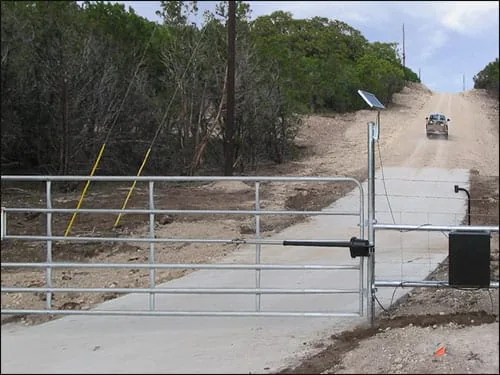
Solar or a wired line: how do you decide?
Start with the distance from the gate to the nearest power you could tap, then count how often the gate runs and what else is hanging off it. Both work here. On a short drive with power close by, a wired line is simple and never thinks about the weather. On a long ranch drive, the trench is often the most expensive part of the whole job.
| What decides it | Solar tends to win when | A wired line tends to win when |
|---|---|---|
| Distance to power | The gate is far from the house, or the drive is long and set back from the road | Power is close, or there is already a line or conduit at the entrance |
| What the trench goes through | The run crosses caliche, limestone, or a finished yard you do not want dug up | The run is short, through soil, or along a path that is already open |
| How often the gate runs | A household's normal comings and goings | Dozens of cycles a day: deliveries, guests, a shared entrance, a business |
| What else is on the gate | The operator, a keypad, and remotes | A cellular call box with video, gate lights, or other gear that draws power around the clock |
| Sun at the post | The panel can sit in open sky, facing south, clear of trees | The entrance sits under heavy oak or cedar cover with nowhere clear to put a panel |
The accessory row is the one people miss. A keypad and a couple of remotes are an easy load. A cellular call box with live video, lighting on the columns, or anything else that stays on all day pulls from the same battery whether the gate moves or not. If you plan to add those, say so at the estimate, because they change the size of the panel and battery, or tip the decision toward a wired line.
Know roughly where the nearest power is (a barn, a well pump, a pole by the road) and whether anything is planned for the entrance later, like a call box or lights. Those two answers settle most solar-versus-wired decisions on the first visit. Call (512) 296-2671 if you want to talk it through first.
Why do solar gates slow down or quit in winter?
Because the panel gets less to work with exactly when the battery needs more. Austin gets roughly ten hours of daylight in late December against about fourteen in June, and the winter sun sits low in the southern sky, so the shadow of an oak or a cedar that never touched the panel in summer can cover it for most of a December day.
Four things stack up from November through February:
- Shorter days. Fewer hours of sun means less charge going back into the battery after each day of use.
- Longer shadows. Trees and buildings that cleared the panel in summer can shade it in winter, and new growth since the install makes it worse.
- A dirty panel. Dust from a caliche drive, and the cedar pollen that coats everything in this part of Texas in December and January, cut the panel's output until someone wipes it off.
- Cold batteries. A battery holds less usable charge when it is cold. On a hard freeze night, a battery that was already tired can drop below what the operator needs to move the gate.
None of that means solar is the wrong choice. It means a solar gate that was borderline in summer, with an aging battery or a panel that is starting to get shaded, is the one that stops on the first cold morning. One of our Google reviewers wrote that her gate "stopped working during the cold snap," the day before Christmas Eve, and we talked her husband through getting it open by hand to make it through the holiday weekend. That is the call we would rather prevent in November.
Solar gate getting slow as the days get shorter? Call (512) 296-2671 for a free estimate, same day in most cases.
What are the signs the battery on a solar gate is going?
The gate tells you before it stops. Watch for these, especially first thing in the morning after a cold or cloudy stretch:
- The gate opens slower than it used to, or slower in the morning than in the afternoon.
- It stops partway, or reverses, without anything in its path.
- It works fine at midday and does nothing at dawn or after dark.
- It gets through a few cycles and then quits until the sun has been on the panel for a while.
- It stays open and will not close. On some operators a low battery parks the gate open on purpose so nobody is locked in or out.
A gate battery is a wear part, and the hot summers here are hard on it. One Texas homeowner on a gate forum traced a gate that was stuck open and ignoring every remote and keypad back to a backup battery more than four years old. If yours is that age and the gate is showing any of the signs above, the battery is the first suspect, ahead of the motor or the board. Our guide to the 7 most common automatic gate problems covers the other causes of a slow gate or a gate that stops partway.
What can I check myself before I call?
Most of what keeps a solar gate running is something you can look at from the driveway in five minutes. Leave the inside of the operator box and the wiring to us.
- Look at the panel. Wipe off dust, pollen, leaves, and bird droppings with water and a soft cloth. A dirty panel is the cheapest fix there is.
- Look at what is around the panel. Check for shade at different times of day, especially from branches that have grown since the gate went in. Trimming a limb often brings a struggling gate back.
- Check that the panel still faces south. Wind, a bumped pole, or a loose bracket can turn it away from the sun.
- Check the wire from the panel to the operator. Look for damage from mowers, livestock, or chewing animals, without pulling on anything.
- Give it a rest. If the gate quits after a run of cloudy days, cut down on cycles for a day or two and let the battery catch up.
- Know your manual release. Find it on the operator now, while the gate works, so you can open the gate by hand if the battery dies on a cold morning. If you cannot find it, call and we will walk you through it on the phone.
If the panel is clean and in the sun and the gate is still slow or dead, it is time for a battery test and a look at the charge controller. We service solar systems on every major operator brand and can usually tell from a photo of the operator box what you have.
What does a solar gate opener cost?
The solar part is the smaller number. A solar power package runs $500 to $2,000, and it is often the cheaper answer on a long drive once you price what trenching a line would take. These are the same figures we publish across the site, and every job starts with a free on-site estimate and one written number before any work begins.
| Solar power package | $500 to $2,000 |
| Basic gate opener with remotes | About $5,000 |
| Basic dual gate opener equipment | About $7,500 |
| Keypad or basic access control | $300 to $2,500 |
| Solar system repair (battery, panel, controller) | $75 to $400 |
| Standard repair visit (depending on issue) | $75 to $500 |
| Full operator replacement | $800 to $2,500 |
Starting points, not a quote. Trenching for a wired line is priced per job because it depends on distance and what is underground. Our guide to what a driveway gate costs in Austin walks through every line, including what Hill Country rock adds to a trench.
Can I switch my existing gate to solar?
Often, yes. If your operator already runs off a battery kept charged by a transformer, which most residential operators do, moving it to solar can be a matter of adding a panel and charge controller sized to how the gate is used. If the operator is built to run directly on line power, it may need to be replaced with one made for solar, and we will say so before quoting.
The same goes the other way. If a solar gate keeps running flat because the entrance is too shaded or the gate is busier than the system was sized for, running a line to it, or adding panel and battery capacity, is the fix rather than replacing batteries every winter. We look at the operator, the power, and how the gate is used on the estimate, and if your gate does not have an opener yet, our gate opener installation and repair page covers putting one on an existing gate.
If your solar gate is slowing down right now
Call and tell us what the gate is doing: swing or slide, how slow, whether it is worse in the morning, and the brand on the operator box. A photo of the panel and its surroundings helps. We have installed and repaired automatic gates on wired and solar power across Austin and the Hill Country since 2008, and we come the same day in most cases. Start with automatic gate repair if the gate is already stuck, or automatic gate installation if you are planning a new gate and weighing solar against a trench. On acreage out toward Dripping Springs or Spicewood, those area pages show what we do there.
Frequently asked questions
Will a solar gate still open when the power goes out?
Yes. A solar gate is not connected to the grid, so a neighborhood outage does not touch it. It runs on its battery, and the panel keeps that battery charged. A wired gate with a healthy backup battery will also keep working for a while during an outage, but only until that battery runs down.
Does a solar gate opener work at night or on cloudy days?
Yes, from the battery. The panel charges the battery during the day, and the gate draws on that stored charge at night and through cloudy weather. A long cloudy stretch in winter, combined with a tired battery or a shaded panel, is when a solar gate runs out.
How long does a solar gate battery last?
Several years, not forever, and Texas heat shortens that. If your gate battery is more than a few years old and the gate is slowing down, have it tested before the first cold snap. Solar system repair, including the battery, runs $75 to $400.